The continual wet weather combined with the dismal world and national news were getting me down. Then Sunday dawned with unexpected sunshine. I had to get outside and decided to walk up the lane near our house. This was four weeks to the day since a previous visit which formed the subject of my last post and I was interested to see how much had changed since then.
Hart’s tongue fern unfurling
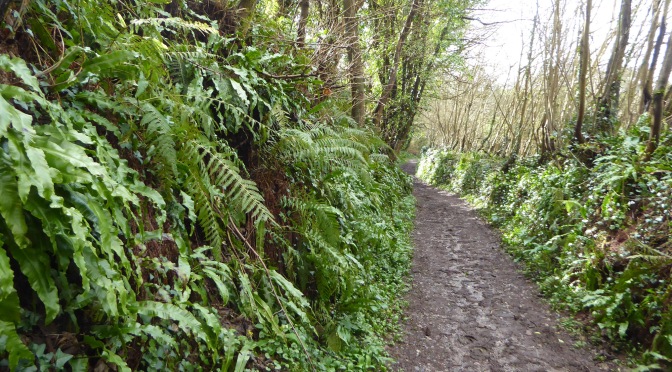
The lane was a mosaic of light and shadow that morning, windy in places with the arrival of Storm Kathleen, muddy underfoot but easy walking. Flowers in different shades of yellow including primroses, dandelions and celandine had been, since my last visit, joined by buttercups to decorate the edges of the lane and there was a general sense of lush growth expressing the life force of spring. Trees were greening, ferns unfurled new fronds and the number and range of flowers had increased with stitchwort and bluebells now enhancing the new season’s celebration. The banks of wild garlic (ramsons) that line much of the lane had filled out. The leaves were now mature and covered the ground although there were still very few of the starry white flowers as if the plants were waiting for a signal to start their show.
banks of wild garlic (ramson) leaves iining the lane
lesser celandine flower with fly
All this was both interesting and therapeutic and I much enjoyed the walk but there were two events that morning that I want to describe in more detail.
Lords and Ladies or cukooo pint
The first was an odd but beautiful sight I encountered nestling on the bank at the side of the path. Pushing upwards through the vegetation was a reddish poker-shaped spear about 5 cm long partly surrounded by a thin, protective green cowl. This is the most obvious part of a very unusual flower and perhaps the most perfect example I have seen. The scientific name of the plant is Arum maculatum and most flower books refer to it as Lords and Ladies. For many years, though, I have known it as cuckoo pint. I have a flower book dating from the late 1960s which calls it cuckoo pint so perhaps that is where I learnt it but how did this unusual name arise?
A little research revealed that the distinctive shape of the flower has generated much ribald humour, often gender related, with the plant attracting a host of local names reflecting this. Some examples are: “Adam and Eve”, “cows and bulls”, “naked boys”, “willy lily”, “Kitty come down the lane, jump up and kiss me”. Apparently, cuckoo pint is another of these. “Cuckoo” has long had amorous connotations and “pint” is a shortening of the old English name pintle meaning a penis. There seems to have been a shift away from this name over the past half century, but I shall continue to call it cuckoo pint, now with an added smile on my face.
Putting the naming aside, the plant is also unusual for its pollination strategy. Hidden at the bottom of the cowl, surrounding the poker-shaped spear are a ring of female flowers, above that a ring of male flowers and then a ring of bristly hairs. When the female flowers are ready, they emit a fetid odour that attracts small flies which enter the flower and get trapped by the bristles. If the flies are carrying pollen, they will pollinate the female flowers and pick up more pollen from the male flowers when they are ready. Eventually, the bristles wither and the flies are released to pollinate another plant. All of this results in clusters of bright orange-red berries along the lane in the autumn.
Further up the lane, a break in the sycamore and hazel scrub on the right-hand side was filled by a small tree covered in white blossom. It caught the sun that morning, looking as though a sudden sharp snowfall had decorated the boughs (see picture at the head of this post). I stood there for a while, enjoying the warmth of the sun, examining the small white flowers, trying to get a good photo. For a short time, I was lost in a dreamy world of flowers and photos!
blackthorn blossom
Suddenly, I felt something nudge the back of my right knee, jolting me out of my reverie. This was a shock and I had no idea what had happened until, when I turned round, there was a small dog looking up at me as if to say hello. Judging from the state of my trousers the dog must have nudged me with a muddy paw.
The dog’s owner soon appeared and was very apologetic. Seeing the white blossom tree that had held my attention, she asked what it was. I explained that this was blackthorn. She replied, saying that it looked so beautiful at this time of year and for her it was “Spring’s bridal veil”.
ashy mining bee (Andrena cineraria) on dandelion
After the dog had nudged me, I had stepped back quickly not noticing some bright yellow dandelions nearby and nearly treading on them. When I looked down there was a honey bee-sized insect on one flower, wallowing in the petals, probably drinking nectar. A closer look revealed that the insect was a furry bee, very fresh with well-defined white stripes on a black background. This was an ashy mining bee (Andrena cineraria) named for the black and white colouration which some see as ashes.
………………………
The lane was a glorious patchwork of light, form and colour that morning and the warmth of the spring sunshine and the sense that nature was moving ahead mostly normally did wonders for my mood. I was very glad to have come out and the poetic conversation with the dog owner was an unexpected bonus.
The signs were all about. Water everywhere, cascading off fields, diving down culverts, even turning part of the path into a temporary brook. All combining to feed the noisy stream in the valley bottom below. All the result of the recent relentless wet weather.
No rain today, though. Instead, it was an unexpectedly sunny morning so I was out following a lane cut into the side of the valley heading into the countryside south of Totnes, not far from our house. The path was muddy underfoot as it climbed gently between steep soil banks and rows of scrubby trees, mostly hazel and sycamore. In summer, this becomes a dark, leafy, green tunnel but at this time of year, with branches largely bare, the bright sunshine created dappled patterns of light and shade. Small birds moved about among the trees singing as they went, the noisy stream gurgled below and the distant peal of church bells echoed across the valley heralding the start of the Sunday morning service.
With all the water about, the soil banks were a mass of lush green growth (see picture at the head of this post). Elegantly arching ferns dominated some places but the heart-shaped leaves of lesser celandine and the round, fleshy, dimpled leaves of navelwort filled in the gaps. The name, navelwort, is a nod to the resemblance of the dimpled centre of the leaves to a part of the human anatomy.
Navelwort growing on the soil banks, look for the dimples in the leaves.
Along the flat edges of the track, tongues of dark green leaves pushed upwards through the compacted wet soil. They were still quite small but the sheer numbers made them difficult to ignore. In a few weeks, the leaves will be full size and will have been joined by masses of white starry flowers providing one of Devon’s finest spring sights. I broke a piece off one of the leaves and savoured the mild garlicky odour for these are ramsons or wild garlic. When the ramsons are fully grown, just walking along the lane, brushing the leaves, will release the smell. Ramsons are popular with foragers and we occasionally use a few leaves to flavour pasta or a risotto.
Ramsons growing in large numbers along the edges of the track
In several places along the lane, creeping mats of small fleshy leaves had formed, mostly green but with patches of greenish yellow lending a golden light to darker areas. This is opposite-leaved golden saxifrage a plant that flourishes in dark, damp places and, even this early in the year, flowers were showing. They lack petals but green bracts surround the yellow flower and its ring of stamens. The plant secretes a globule of nectar to attract pollinators and on this mild morning I saw a few flies taking advantage of the sugary feed.
Opposite-leaved golden saxifrage showing the “gold” that lights up the darker parts of the lane
Close up view of the yellow flowers of opposite-leaved golden saxifrage showing the ring of stamens
A fly feeding from the nectar on flowers of opposite-leaved golden saxifrage
Further on, parts of the lane were more open allowing the morning sun to warm the soil bank. Large clumps of primroses flourished here as if in a microclimate. As I stood in the sunshine, gazing at the pale yellow flowers, my reverie was interrupted by a loud buzz announcing the arrival of a large buff-tailed bumblebee queen (Bombus terrestris). She flew about near the bank, seemingly investigating the vegetation before landing on a primrose leaf to bask in the sun. She looked sleek and fresh, yellow and white bands well defined, her coat glistening in the sunlight. She may have been setting up a new nest in the bank and finding me here will have surprised her. I moved on, leaving her in peace but wondered how she had been faring in our recent wet weather when flying must have been difficult.
Primroses growing in a sunny part of the lane
Bumblebee queen basking on a primrose leaf
The lane eventually meets a road and this allowed me to complete a circular walk back to our house. When I set out, I wondered how the plants that grow along the lane would have been affected by the recent very wet weather, but I needn’t have worried. I had seen many welcome signs of seasonal renewal that morning with the queen bumblebee perhaps being the most prominent.
To finish, here is a poem by William Wordsworth entitled “Lines written in early spring” that seems appropriate:
I heard a thousand blended notes, While in a grove I sate reclined, In that sweet mood when pleasant thoughts Bring sad thoughts to the mind.
To her fair works did Nature link The human soul that through me ran; And much it grieved my heart to think What man has made of man.
Through primrose tufts, in that green bower, The periwinkle trailed its wreaths; And ’tis my faith that every flower Enjoys the air it breathes.
The birds around me hopped and played, Their thoughts I cannot measure:- But the least motion which they made It seemed a thrill of pleasure.
The budding twigs spread out their fan, To catch the breezy air; And I must think, do all I can, That there was pleasure there.
If this belief from heaven be sent, If such be Nature’s holy plan, Have I not reason to lament What man has made of man?
…………………………………………………
I completed this walk on March 10th 2024. For more information on the lane I walked, please click here.
Slapton Ley in south Devon is a narrow, elongated lake with extensive beds of pale brown reeds at either end. The lake is a beautiful place but also a nature reserve and a popular haunt both for wildfowl and for birders. It is inland but only just, separated from the sea by a long shingle bank wide enough to accommodate a road and pebbly beaches.
Slapton Ley looking south. The shingle bank and road are to the left with the sea behind. The path I walked is to the far right of this picture
It was the first week of February, a mild day with cloud enveloping the area and shutting out the sun but at least it was dry. An unpredictable gusty wind blew from the sea but the path along the inland side of the Ley was partly sheltered by trees and scrub . Even here the wind managed to make itself felt but I found the windy conditions to be surprisingly invigorating and refreshing. As I walked, skeletal branches clattered around me, waterside reeds vibrated, remnant fallen leaves skittered about and the surface of the Ley was stirred up into waves and spray lending the water a rough, mobile texture. With all this motion and noise, it was as though the wind was suffusing the air with energy, one that was infectious. I noticed a gang of gulls across the Ley that seemed to pick up on this energy as they flew up and down and around one another above the water like pieces of paper caught in an updraught.
I had come here to be out in the countryside but also hoping to spot seasonal changes so I concentrated on looking for early spring flowers along the Leyside path. At first the path is part of a broad wooded area with the water on one side shielded by reeds but gradually the rough track narrows to run close to the edge of the Ley with trees growing in the shallow watery area and rising ground on the inland side. Flowers were generally few and far between but it was still quite early in the year.
I did, though, see lesser celandine dotted around the site, their bright yellow-petalled flowers speaking of the sunshine that was so absent on this gloomy day. Lesser celandine flowers had also started to appear around Totnes where I live.
lesser celandine
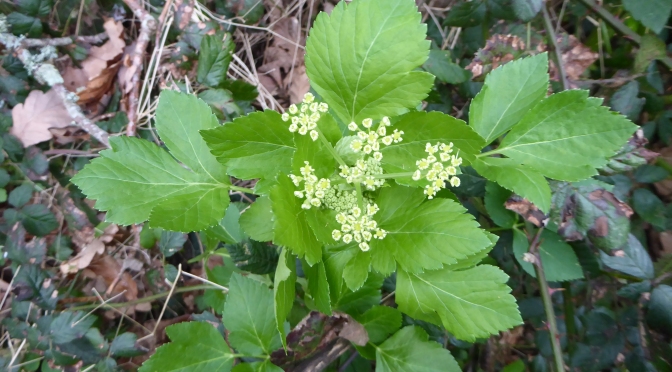
There were also quite a few clumps of Alexanders with their copious sprays of shiny dark green leaves (see picture at the head of this post and below). Most of the clumps had small umbels comprised of many yellowish-green flowers and these were attracting a few flies, the only insects I saw that day. Alexanders is said to have been introduced to the UK by the Romans and now favours mild areas, often near the coast. It was once used widely in cooking but fell out of favour with the popularisation of celery.
Alexanders showing the green foliage and some flowers with a lone fly
These were the two principal flowers I saw that day. Both appear early in the year in south Devon and both are early signs that winter is beginning to slouch away. I did, though, come across one or two of each of the following species:
primrose
red campion
three-cornered leek
So, a few more signs of spring but the new season still felt some way away that day.
Since then, carpets of lesser celandine have appeared in places around Totnes and on the one or two sunny days we have experienced, there has been a hint of spring in the air. It has, though continued very wet with local flooding.
As I returned to the car, I passed some information boards showing what species might be seen at Slapton Ley in different seasons. On the autumn/winter board there was also a poem by Anne Bronte entitled “Lines composed in a wood on a windy day” which nicely sums up my experience that day. Here is the poem:
My soul is awakened, my spirit is soaring
And carried aloft on the wings of the breeze;
For above and around me the wild wind is roaring,
Arousing to rapture the earth and the seas.
The long withered grass in the sunshine is glancing,
The bare trees are tossing their branches on high;
The dead leaves beneath them are merrily dancing,
The white clouds are scudding across the blue sky
I wish I could see how the ocean is lashing
The foam of its billows to whirlwinds of spray;
I wish I could see how its proud waves are dashing,
A few days before Christmas, we visited the coastal town of Lyme Regis in west Dorset to have lunch with my sister and to exchange gifts. Lyme was uncharacteristically very quiet, there were few people about and even the usually predatory gulls were subdued. We had a pleasant time and I managed to fit in a short walk around the seafront gardens that overlook the beach and promenade.
Part of the seafront gardens in Lyme Regis. To the east, the Dorset coast rises and falls.
From their elevated position, the gardens provide good views across Lyme Bay and along the Dorset coastline as it rises and falls in a series of hills and cliffs like a wave sweeping eastwards. The gardens are also a fine place to watch the weather, changeable, blustery and mostly grey that day with storms plus rain moving about, fortunately well out to sea. Occasionally, the sun broke through the cloud spreading silvery light across the water and to the east, sections of the coastline lit up briefly as the light came and went. The sun also illuminated the harbour with its sinuous sea wall known as the Cobb. The Cobb is a local landmark dating from the 14th century and something about it, perhaps its prominent position, perhaps its pleasing shape has caught the imagination of writers. For example, it is the site of an important plot twist in Jane Asten’s novel Persuasion and it is where Meryl Streep stands in the film of John Fowles novel, The French Lieutenant’s Woman
Lyme Regis harbour illuminated by the sun after a break in the cloud. The curving rear wall of the harbour is known as The Cobb.
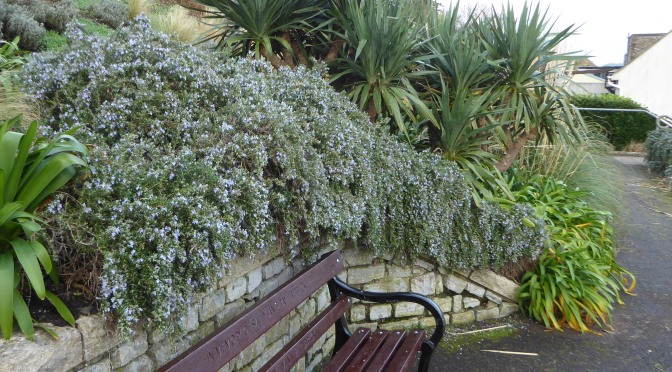
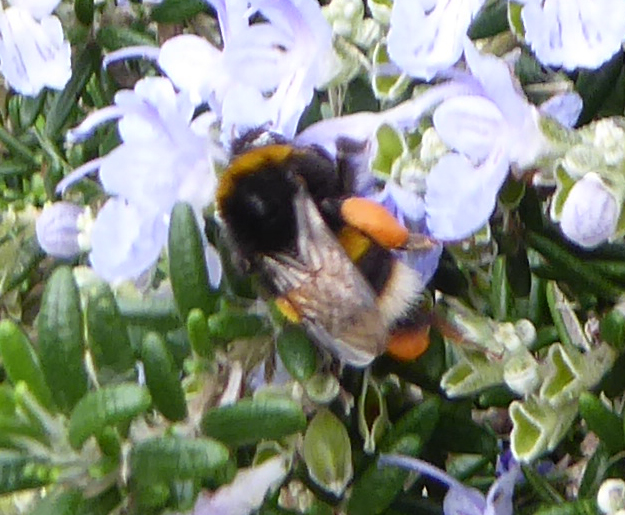
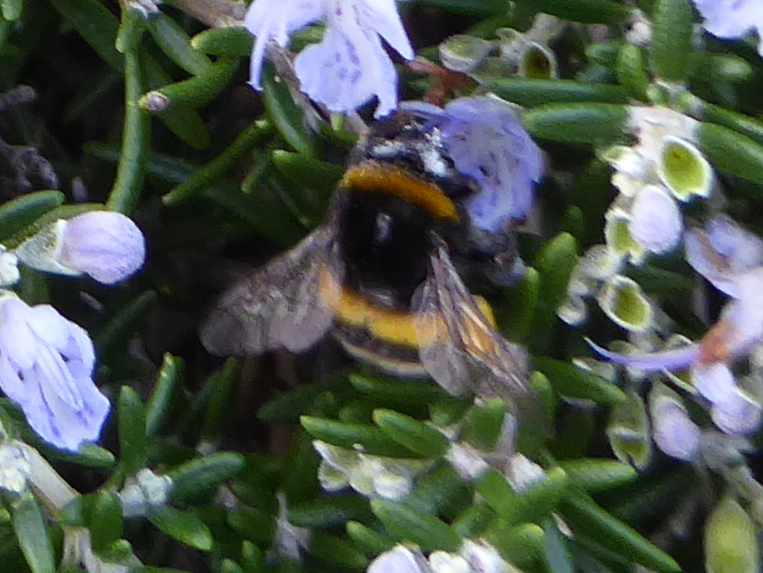
The gardens rise steeply from the promenade across a hillside in a series of terraced borders separated by paths. Even at this low time of the year, the borders looked smart and well-tended. Spread across some were extensive banks of rosemary with its aromatic needle-shaped leaves and a good covering of fresh, grey blue flowers lending the area a blue sheen (see picture at the head of this post). The rosemary was proving popular with small bumblebees and I saw six or more in a short space of time. They moved quickly between flowers stopping only briefly and, on their back legs, they were all carrying large lumps of sticky pollen, some orange yellow, some off-white. With their white and yellow stripes on a black background and their small size these were most likely buff-tailed bumblebee workers (Bombus terrestris). Interestingly, I saw no other insects that day.
One of the bumblebee workers foraging on rosemary.
Another bumblebee worker.
Although most bumblebees hibernate in winter, some buff-tailed queens set up winter colonies in the late autumn, mostly in the milder south of the UK. The workers I saw were collecting pollen and nectar for one or more of these winter active nests each with a queen laying eggs. At Lyme Regis, the colonies are encouraged by the mild south facing seaside conditions and the extensive floral resources. The general shift to warmer winters with climate change must also be a factor
As I watched, I remembered that the following day was the day of the winter solstice. This is the day when the Northern Hemisphere reaches its maximum tilt away from the sun and we experience the shortest day of the year with subsequent days becoming gradually longer, if only by a few minutes. The winter solstice was very important for ancient people who were mostly farmers and needed to be aware of the seasonal cycle. The winter solstice signified the gradual return of the light, with the promise of spring and they built temples like Stonehenge to celebrate this. Observing the solstice at places like Stonehenge has become popular nowadays. Those watching speak of using the time to reflect, looking backwards on the past year and forwards to the new.
Watching the winter active bumblebees, I am also looking forwards to the new. How the colonies proceed will depend on the weather over the next few weeks but the lengthening days will allow the workers more time to forage providing the conditions enable them to get out. Hopefully new queens and males will emerge in early spring and the cycle will start again, alongside queens emerging after spending the winter in hibernation.
One of my abiding memories of childhood is of throngs of colourful butterflies gathering on a buddleia shrub in our road. We called it the “butterfly bush” and one of the species was the red admiral (Vanessa atalanta), easily recognised with its bright orange-red stripes and irregular white spots. We don’t see these throngs anymore, a result of human degradation of the environment, and children growing up today would not recognise a “butterfly bush”.
Red admirals in variable numbers, though, are still a feature of our summers and 2023 was a bumper year. The Big Butterfly Count, a citizen science survey, recorded a 400% increase in sightings, possibly a result of climate change. Red admirals normally migrate to the UK from North Africa and continental Europe in the spring to lay eggs with new season’s progeny returning in the early autumn. This year’s extreme temperatures in continental Europe may have caused an unusually large influx of the butterflies with a corresponding return in the autumn.
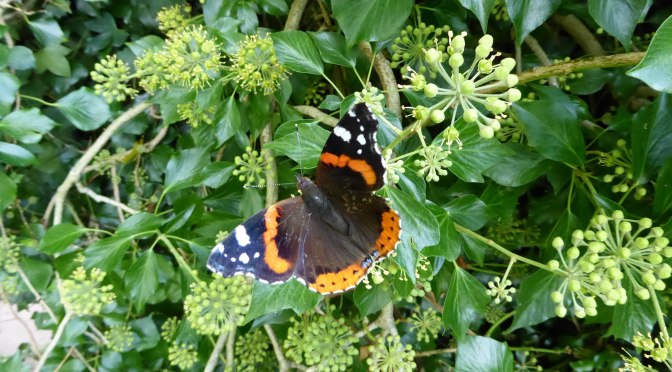
I didn’t notice any increase in numbers in our garden across the summer despite having plenty of flowers but in the last week of September significant numbers appeared. The peak day was September 29th when I saw ten red admirals feeding together in the sunshine on the hedge along one side of the garden, an unexpected feast of colour. The first flowers had appeared on the ivy that grows there and the butterflies were binging on ivy nectar. Sightings continued into October even as the weather had begun to deteriorate. There were reports from the Devon coast of large numbers of the species migrating south in late September so perhaps those in our garden were refuelling.
Two red admirals on ivy, seen on October 23rd.
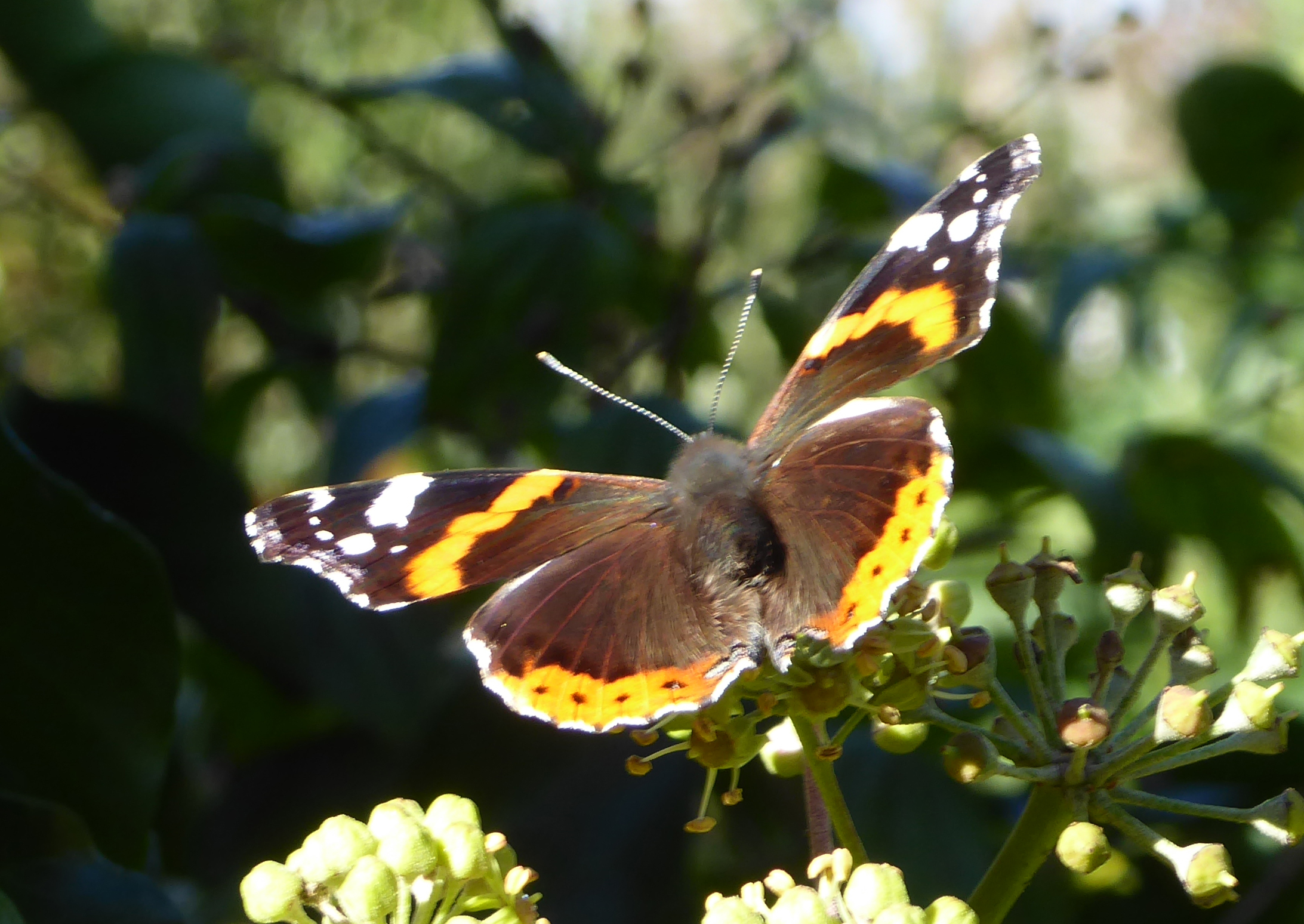
With so many red admirals about, I was able to watch them more closely. They appear very relaxed as they feed, laconically flapping their wings but a closer look shows the insects continuously probing the flowers for nectar (see video below). Their upper wings with orange-red stripes and white spots on a dark background and their furry dark abdomen make them vividly unmistakeable but when they close their wings they merge into the background. The hind underwing looks like tree bark and the fore underwing an understated version of the upper side but with a few blue decorations (picture below).
The more I looked at the butterfly, the more I saw one of nature’s wonders and it’s no surprise that until the 19th century it was known as the red admirable.
A red admiral with wings closed showing the underwings
A short video of a red admiral feeding from the ivy flowers
The river Ashburn in its stone-lined channel near the centre of Ashburton showing the large bank of ivy and to the right, North Road
As the river Ashburn approaches the centre of the south Devon town of Ashburton on its descent from Dartmoor, it runs along a stone-lined channel close to North Road giving the area a distinctly watery feel. The rapidly running water attracts wildlife so I always stop to look.
Today, a long section of the wall on the road side of the stream is covered in ivy which at this time of year (late September) is in full flower. Each flower head contains many small pale green hemispheres each topped with five yellow pollen-laden stamens. The overall effect is to give the normally dark green bush a temporary pale green coat with a glistening yellow sheen. The flowers are a rich late season source of pollen and nectar and give off a sickly-sweet odour perfuming the surrounding air, providing an irresistible lure for insects.
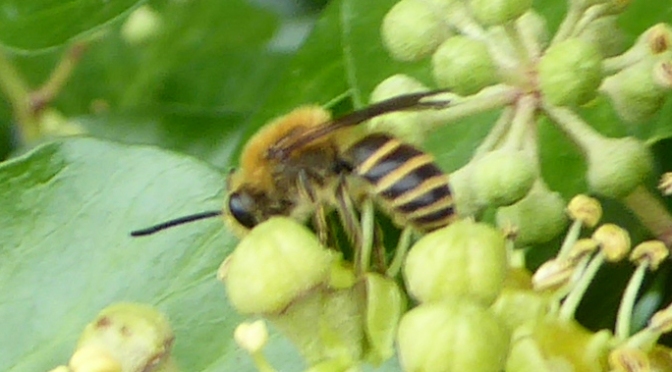
There is a cool blustery wind but there have been hints of sunshine and I notice some wasps and honeybees feeding from the ivy along with one or two distinctively marked bees with bright yellow hoops around their abdomen (see picture above and below). With their pale chestnut-haired thorax, these are ivy bees (Colletes hederae) our last solitary bee to emerge each year with a strong preference for feeding from ivy. These are males as their back legs lack pollen collecting hairs. They move about quickly from flower to flower and are very jumpy. They are waiting for females to emerge and their enthusiasm sometimes bubbles over into misguided mating attempts between males.
I can’t help glancing at the running water and suddenly I notice a flash of white. It’s rather far away so I use my camera zoom and find that this is a bird standing on a branch in the water. Photos show its chocolate brown plumage and a prominent white bib, unmistakeably a dipper (Cinclus cinclus). Dippers are elusive birds, at home by fast running water but always on the move and they get their name from the frequent bobbing movements they usually perform. This one seems more interested in preening and stretching its wings but it does a little dip for good measure (see video below).
I look back to check on the bees for a few moments but when I return to the dipper, it has already moved on.
Two male ivy bees on a head of ivy flowers
Two overexcited male ivy bees
A still photograph of the dipper
I visited Ashburton on September 27th 2023 and all the photos and the video were taken on that day,
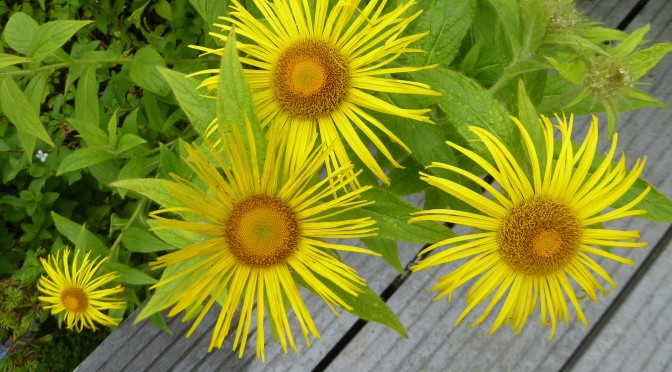
One of the late summer pleasures of our south Devon garden is the appearance of a drift of striking bright yellow daisy-like flowers in one corner. These are the flowers of elecampane, a robust perennial that can grow up to a metre tall. The flowers, each about 8cm across, contain a central disc containing many florets surrounded by thin rays so that each bloom resembles a small sun.
The proper name of elecampane is Inula helenium. Helenium may be a reference to the sun (helios) or it may be a nod to the Greek myth of Helen of Troy. According to this myth, Helen of Troy wept bitterly when she saw the city of Troy burning and as her tears fell to the ground, bright yellow flowers sprung up. These were elecampane.
Our clump of elecampane began to flower this year in early July filling this part of the garden with yellow light. It continued to flower into August and has been very popular with insects, attracting a variety of species of bees, hoverflies, flies and butterflies as long as the sun shone. I spent rather too much time standing by the flowers fascinated, trying to identify each of the many visitors. Here are a few examples of the species I saw.
Small tortoiseshell butterfly feeding from elecampane. If you look carefully the proboscis is visible in this picture
One of my favourites was a butterfly, a small tortoiseshell (Aglais urticae), a species once very common in the UK but recently much declined. A very fresh example appeared one afternoon allowing me to look at its beautiful markings. Although the overall impression of the butterfly was dominated by large orange patches, I was particularly taken by the rear border of the wings, a fine pattern of blue and yellow, resembling medieval stained glass.
Grey-banded mining bee on elecampane. The florets in the central disc open in concentric rings, outside first, spreading inwards gradually. The insect feeds only from the open florets and so tends to move in circles.
The butterfly fed for some time but was repeatedly attacked by small bees feeding on neighbouring elecampane flowers. These bees seemed to object to the butterfly foraging even though there was no shortage of flowers. They also acted aggressively towards other insects much larger than themselves such as bumblebees and hoverflies when they came to feed. These small bees were about the same size as honeybees but notable for the prominent bands of grey/white hairs encircling their abdomen. With some help, I worked out that these were grey-banded mining bees (Andrena denticulata).
Leafcutter bee (Megachile sp.) on elecampane
Another regular visitor to the flowers was a chunky bee with a distinctive ridged abdomen and pale hairs below. This was one of the leafcutters (Megachile sp.), a genus that builds nests in cavities using segments of leaves or petals. It would have been good to identify the species of Megachile but a photo from above doesn’t provide enough information.
Sharp-tailed bee (Coelioxys sp.) on elecampane
On two occasions I also saw another bee with an altogether different look. Its abdomen was slender, tapering to a point, and was decorated with prominent white bands of hair. This was a sharp tailed bee (Coelioxys sp), a parasite of leafcutter bees. The sharp-tailed bee uses its pointed abdomen to pierce the host leafcutter bee nest cell and insert an egg. The Coelioxys larva then takes over the nest, killing the host larvae and consuming the stores of pollen and nectar left by the host.
Elecampane is clearly very popular with insects but it also has a long history of use in human medicine. It is a native of south eastern Europe and Asia and its medicinal properties were known by the ancient Greeks. The Romans were also aware of the medicinal virtues of the plant and were probably responsible for bringing elecampane to this country.
The plant was grown in cottage gardens in the UK and was used in folk medicine to treat respiratory conditions such as asthma, consumption and whooping cough. As official medicine developed in the 16th and 17th centuries, some of these folk remedies were adopted by medical practitioners. Elecampane was one of these remedies and was recommended for many conditions including shortness of breath. The root was candied and pieces were eaten each morning and evening for asthma-type disorders. Contemporary medical herbalists still use the plant for treating asthma and lung conditions.
Elecampane has also been used for supporting respiratory health in horses and goes by the alternative name of “horse-heal”. And if all this weren’t enough, the flowers of elecampane, left to go to seed, are very popular with birds.
St Andrew’s Church, Ashburton, from the churchyard (from Wikipedia)
A sunny day after so much mixed weather was too good an opportunity to miss. My wife, Hazel, had an appointment in Ashburton that morning and although I still felt fatigued, I decided to go with her. Ashburton is a pleasant town on the southern edge of Dartmoor, with green hills rising around the town’s northern side. It’s about a half hour drive for us along the valley of the river Dart and in the last week of April the countryside looked very fresh with spring flowers lending the roadside verges a veneer of colour.
Ashburton is one of four Dartmoor ”stannary” towns, mentioned in records as early as the 12th century. Stannary towns were centres for collection and assessment of purified tin, a product of mining on the moor. More recently, peaking in the early 19th century, there were several mills in the town making cloth from the wool of sheep farmed on Dartmoor. This industrial activity brought prosperity to the town and there are some fine old buildings in Ashburton giving it a solid established feel. Nowadays, Ashburton has many antique shops, a developing foodie culture and a flourishing Arts Centre based in the former Methodist Church. And, last but by no means least there is a lovely, funky café serving excellent coffee. Traffic, though, is a problem. The town’s roads are littered with cars and the nearby Devon Expressway creates a continuous, intrusive background roar.
Although the sun was shining, it wasn’t especially warm so I sat on one of the sheltered benches on the broad grassy area at the front of St Andrew’s Church. Around me on the grass were many bright yellow dandelions and the sunshine had coaxed out honeybees that moved systematically from flower to flower collecting forage. It was pleasant sitting in the sun, but I soon had enough of watching honeybees and curiosity drove me to explore. A path took me to the back of the church where I was surprised to discover an extensive churchyard with many graves but also many flowers. Mostly these were dandelions growing in the grass between the graves but other flowers had been planted around some headstones. A large group of bluebells in full flower stood out around one grave lending the air a haze of blue light and attracting insects in the sun. A few people were about in the churchyard, quietly visiting or tending graves and now and then the church clock rang.
Further on, though, as the graveyard widened even more, I spotted a large bank of a plant with tall stems almost reaching up to my waist, and topped by clumps of small green and white flowers. I recognised this as garlic mustard a common wildflower that grows widely in the local countryside along hedgerows as its common name, Jack by the hedge, encapsulates. Here in the churchyard, it was growing prolifically by a perimeter hedge where it gave the area a distinctly wild feel. Its stems were covered in pale green heart-shaped leaves and I crushed one to remind myself of its mild garlicky smell.
The churchyard with the patch of garlic mustard
I get very excited when I find this wildflower in the spring as it is one of the larval food plants of the orange tip butterfly, a very beautiful insect and one of my favourites. I hadn’t expected to find it in this semi-urban space and hoped that the butterflies might be there too. There was certainly no shortage of the flowers but despite this, no butterflies deigned to appear. In part compensation, the flowers were proving very attractive to several of our spring mining bees, insects that nest in holes in the ground. I saw three species, each carrying pollen so female, each looking very fresh, with bright markings allowing me to identify them as the Yellow-legged mining bee, the Ashy mining bee and the Grey-patched mining bee (Andrena flavipes, Andrena cineraria, Andrena nitida, respectively). I also had a quick glimpse of a bee fly nearby, an insect that parasitises the nests of mining bees so most likely there were nests about.
Yellow-legged mining bee (Andrena flavipes)
Ashy mining bee (Andrena cineraria)
Grey-patched mining bee (Andrena nitida)
It was good to see the flowers and the bees although the lack of butterflies was frustrating but I decided it would be worth another visit. Three weeks later, Hazel had another appointment in the town, so I tagged along, having by then a bit more energy. In those three weeks spring had arrived in Devon. The weather was much warmer, hawthorn blossom lined the road through the Dart valley and we spotted one or two pink orchids growing defiantly by the road as we approached Ashburton. After our obligatory visit to the funky cafe, Hazel went for her appointment and I went straight to the churchyard. Here there was change as well. The area behind the church was less colourful, the dandelions had gone to seed and the bluebells were now a faded grey-blue. The garlic mustard was even taller and the stems moved together in waves as that morning’s light wind played across the area. There were still plenty of flowers on the garlic mustard but they had been joined by a large patch of another wildflower, greater celandine with its many yellow flowers and their tissue-paper petals. Hawthorn in the perimeter hedge was now covered in creamy white flowers perfuming the air with its odd smell that some say reeks of sex and death. With the warm sunshine, the mild weather and all the flowers, I had great expectations for orange tip butterflies but these were once more unfulfilled. Indeed, there were few insects about, a few honeybees moving around the garlic mustard and two or three rather jumpy bumblebees. The general lack of insects that warm day was very surprising and quite worrying.
Then as I stood by the flowers, I became aware of something in the air moving backwards and forwards across the patches of celandine and garlic mustard. I couldn’t see exactly what it was, but I began to think it might be a dragon fly as it seemed to swoop rapidly above the flowers before rising again, turning quickly to repeat the passage, occasionally hovering. I watched it for a while and saw it land on a dry woody stem. It was indeed a dragon fly, a fine insect about 5cm long with thorax and head a shiny mid brown, a chunky, yellowish-striped abdomen and its wings held horizontally showing their pattern of many tiny panes. It stayed still for long enough for me to take some photos and these identified it as a broad-bodied chaser (Libellula depressa), a female or an immature male with this colouration. After more flying about, it moved to the hawthorn hedge where it basked in the sun, its wings catching the light and glinting like stained glass, creating tiny flashes of red and green.
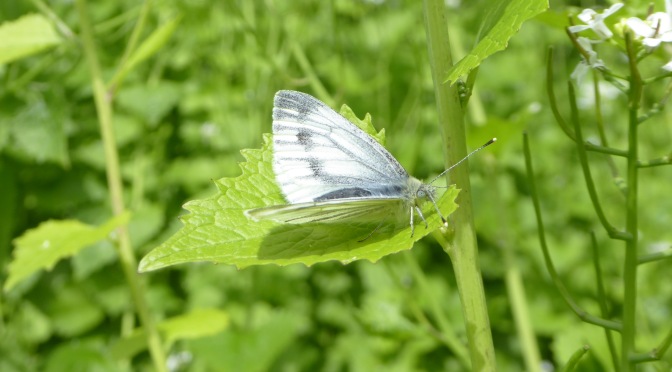
That was very exciting but I still hoped for butterflies and then, just as I was about to give up and leave, one appeared on the garlic mustard, a white butterfly but not an orange tip. It flitted among the flowers pausing briefly before resting in the sun, its wings open. Glimpses of the underwings (see picture at the head of this post) showed clear pale green striations and the pattern of spots on the upper wings indicated that this was a green-veined white butterfly (Pieris napi). These unexpected arrivals in the churchyard were very welcome but one dragonfly and one butterfly don’t change the fact that there were very few insects overall.
Broad-bodied chaser (Libellula depressa)
Green-veined white butterfly (Pieris napi)
By now Hazel had reappeared and we decided to have a look at the inside of the church. The building dates from the 15th century and has a fine spacious interior, steeply curved wooden wagon roofs and much Victorian stained glass. We looked about and high on the roof above the Lady Chapel we found several colourful medieval roof bosses, carved wooden plates covering the join between two roof joists. One of these bosses depicted a human head with foliage protruding from its mouth, painted in bright colours, a rather surprising image. These unusual figures are, in fact, quite common, and are found very widely in varying forms in churches in Devon, the rest of the UK and elsewhere in Europe. They are popularly called “Green Men” although a more correct term is “foliate head” (a male head with leafy sprays growing from the mouth or eyes). There are said to be four Green Men in the Ashburton church. We found two more on the fine Victorian carved oak screen by the choir stalls.
Green Man (foliate head) roof boss in St Andrew’s Church, dating from medieval era
Green Men have been in the news recently following the inclusion of a prominent Green Man in the official invitation for the Coronation of King Charles III. The rationalisation given by the Royal Family for the use of the figure was as follows: “Central to the design is the motif of the Green Man, an ancient figure from British folklore, symbolic of spring and rebirth, to celebrate the new reign..”
The Coronation Invitation with the Green Man
Although Charles has long been an advocate of nature and has criticised the way we treat the natural world, I was surprised at the use of the Green Man image in this context. The explanation given by the Royal Family seems like a comforting oversimplification as we don’t actually know what the Green Man/foliate head means. We don’t know why so many appeared in churches and we can never know what they symbolised in the Medieval era when they first appeared. Many theories have been proposed about what these images might mean, including that they have no symbolic meaning.
My principal concern about using the Green Man in the invitation, surrounded by flowers, and specifically linking it to rebirth and spring is that it could give the impression that there are no problems with the natural world and spring is returning as always along with the rebirth of nature.
The reality is rather different. We are firmly in the grip of a biodiversity crisis and recent statistics highlighting the decline in birds and insects are alarming: between 2015 and 2020, 48% of all UK bird species declined and in the last 20 years, UK flying insect numbers fell by 60%. Anecdotal observations this spring, including my observations in Ashburton, suggest a sudden additional decline in insect numbers in some parts of the UK.
Outside of the naturalist community there is no discussion of these losses or what might be causing them. There is also no strategy, government or otherwise, for halting this downward spiral. Without this context, use of the Green Man as a symbol of spring and rebirth risks accusations of greenwash.
I haven’t posted here for a while but there is a reason. I’ve been unwell with some kind of post viral fatigue and that has prevented me from getting out very much or writing.
In the meantime, here is an article I wrote towards the end of last year that has just been published in the Marshwood Vale Magazine. It describes a visit I made to Topsham in East Devon on November 29th 2022 searching for avocets and other birds on the mudflats around the estuary of the river Exe.
A gull on a post in the Exe estuary
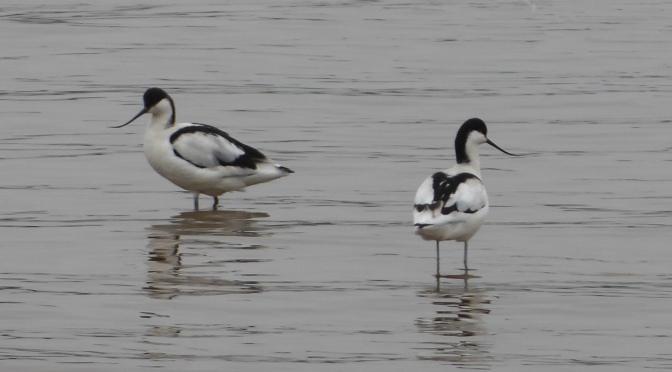
As it approaches the sea, the river Exe swells into an impressive estuary about eight miles long and up to a mile wide. The Exe estuary is strongly tidal, a place of ebb and flow where massive amounts of water move back and forth and vast areas of mudflats emerge twice each day as the tide falls. Estuary mud may look uninviting but it is a rich habitat for tiny worms and crustaceans and as rich in biodiversity as a tropical rainforest. Wading birds love this plentiful environment and many species overwinter here and can be seen feeding from the mud. One iconic winter visitor to the Exe is the avocet, a beautiful black and white wading bird (see picture at the head of this post).
The town of Topsham on the eastern side of the estuary makes a good gateway for anyone interested in learning more about local bird life on the mudflats. The railway station is easy walking distance from the town and there is plenty to see in Topsham itself. The river has always been an important influence on the town and Topsham was once the second busiest port in England and an important centre for shipbuilding. Times change and nowadays Topsham is a favoured destination for the retired and for tourists alike, its narrow streets packed with enticing cafes, restaurants and gift shops but also cars.
The Strand in Topsham showing the houses with Dutch gables
Many fine houses were built here in the 17th and 18th centuries by prosperous merchants when maritime trade through Topsham was in its heyday. These houses can still be seen, seemingly unchanged, along the main streets as they descend to the quay and river. Perhaps the most overtly impressive street is the Strand, running parallel to the river beyond the quay, lined with elegant old houses many built with curved gables in the Dutch style. There was a busy trade with the Netherlands in the 17/18th centuries exporting woollen cloth made in Exeter mills. Ships returned from Holland carrying Dutch bricks and tiles as ballast which were used to build the houses, inspired by Dutch design.
Avocets at lowish tide, from the Goat Walk
But what about the mudflats and the birds? If we walk along the Strand until the houses peter out, we reach a raised concrete walkway along the river. This is the Goat Walk and gives good views across the water to the salt marshes and reeds on the west bank of the Exe and downstream towards the river mouth. At high tide, the water comes up to the edge of the walkway but as the tide falls, mud is quickly revealed and wading birds can be seen foraging for food. If you stand here quietly on a winter’s day you may also hear the plaintive, keening call of the curlew echoing across the water.
Low tide mud flats on the Exe from the Goat Walk at Topsham with a curlew calling
At the end of the Goat Walk the path turns sharply to the left on to Bowling Green Road with the RSPB (Royal Society for the Protection of Birds) nature reserve appearing in a short distance. This gives access to a viewing platform looking out across the water where the rivers Clyst and Exe merge. As the tide falls, vast swathes of mudflats appear, attracting flocks of waders. The dark mud with its film of water acts as a perfect mirror capturing an image of the sky and clouds above, punctuated by whatever waders choose to feed.
Further down Bowling Green Road is the RSPB Hide which gives unique views across marshy land with small lakes and reed beds at the confluence of the Clyst and Exe rivers. This is the main high tide roosting place for birds on the northern part of the Exe estuary and large numbers of waterfowl and waders may be seen. I once saw a huge flock of godwits grazing here and suddenly taking flight, a breath-taking experience as they wheeled back and forth catching the sun.
Avocets gathering near the bird hide at Bowling Green Marsh
In the winter, though, the star species on the mudflats is the avocet a very distinctive black and white, long-legged wader with an extended, slightly upturned beak that it uses for finding food in the mud. The birds arrive on the Exe by November and may be seen on the mudflats off Topsham into February. Sometimes they gather in large flocks feeding not far from the RSPB hide.
Avocets are elegant birds and something about them has captured the local and national imagination. For example, the railway line along the estuary linking Exeter, Topsham and Exmouth is now called the Avocet Line. Beyond Topsham the railway runs close to the river making avocet sightings possible from the train in winter. The Exeter Brewery is another avocet advocate and features the bird in its logo. Perhaps the greatest tribute to the bird, though, was the adoption from 1970 of the bird as the logo of the RSPB, celebrating a major conservation and protection success story.
The avocet was extinct in the UK by 1840 having been driven over the edge by marsh drainage, destroying important habitat, and by hunting and egg collection. The occasional bird still arrived in the UK but was usually shot to satisfy the fashion for stuffed birds as living room ornaments. Paradoxically, a century later, the turmoil of World War 2 opened a window of opportunity for the birds to re-establish in the UK.
With the threat of a German invasion, the low-lying Suffolk coast was considered particularly vulnerable. Various physical defences were erected on beaches but another strategy included the deliberate flooding of coastal marshland around the Minsmere river to hamper invading forces. After the war, the water was allowed to recede creating a mosaic of shallow pools and reedbeds, a haven for wildlife. In 1947, the RSPB took over managing the site and in the same year seven pairs of avocets nested on the Minsmere reserve. The birds were guarded carefully and by 1949, after some ups and downs, 40 young avocets fledged. This is one of the most successful conservation and protection stories and nowadays, avocets breed along the East coast of the UK in good numbers each summer.
In winter, many migrant avocets arrive in the UK especially in the south west. Several hundred birds overwinter on the Exe estuary each year and even greater numbers may be seen around Poole Harbour. The birds come for the milder weather and for the mudflats with their rich biodiversity and the well-stocked winter larder they provide for these migrants.
The Christmas weather had been poor but Boxing Day (December 26th) was mild, clear and bright and the seafront at Paignton in south Devon was thronged with people promenading in the sunshine and as busy as I have ever seen. Some had also come to watch “Walk into the sea” a charity event where hardy souls, often in fancy dress, splash in the cold waters of Torbay.
A short video of Walk into the Sea 2022, from Youtube
It was good to see all the people enjoying the weather but I was here for a different reason. I left the crowds behind and headed past the little harbour towards Roundham Head, a promontory that protrudes into the waters of Torbay. Here I found Roundham Head Gardens, public gardens built on the sloping, south-facing side of this headland where narrow paths zig zag up and down the cliff face between borders planted with many exotic species. Some of these plants flower throughout our winter providing an unusual micro environment.
Scorpion vetch (Coronilla valentina) (see picture at the head of this post), a native of the Mediterranean, is one of the plants that flourishes here and the low winter sun seemed to accentuate the lemon-yellow colour of its pea type flowers. In the same border overlooking the sea I also found some bergenia flowers, an almost psychedelic pink in this low light.
The view to the south from the Roundham Head Gardens showing the low winter sun
It wasn’t just the humans who had been drawn out by the mild sunny weather, there were also a number of insects about. A small furry bumblebee had discovered the scorpion vetch and was systematically visiting each flower to feed. Her black, white and brownish-yellow banding stood out like a furry bar code and she carried a yellow lump of sticky pollen on each rear leg. She was most likely a worker buff-tailed bumblebee (Bombus terrestris) and I watched her track across the clump of flowers.
Bumblebee worker with pollen, feeding from Scorpion Vetch
Eventually, I had to move to the far side of the border to get a better view of the small bee, but I hadn’t noticed the large queen bumblebee feeding on the bergenia. She objected to my presence and flew away buzzing loudly after circling closely around my head. Was this a warning or was she just having a look? I only got a quick glimpse but she looked like a buff-tailed bumblebee queen, our largest bumblebee species. Later, I got a much better view of one of these huge insects basking in the sun on an old stone wall. This one was the size of the distal section of my thumb, very furry and with clear black and orange-brown bands and a brownish tail.
Queen Buff-tailed bumblebee (B.terrestris) basking on old stone wall
As I wandered about the enclosed paths, I encountered more small buff-tailed bumblebees, often feeding from the slate blue flowers of the rosemary that grows well here. Most of these were carrying pollen of different colours, white, yellow or red, so they were all workers.
Bumblebee worker carrying reddish pollen and feeding from rosemary
This winter bumblebee activity is probably a consequence of the mild marine environment in these gardens and the profusion of flowers that grows here even in the lowest months. The worker bumblebees will be supporting nests begun by queens a few months ago, whereas the queens I saw may be preparing to set up new nests that will last across winter.
A return to the first border gave another surprise: a red admiral butterfly basking on bergenia having been tempted out by the warm sun. As I watched it flexing its wings, another floated past my shoulder before disappearing. I shared my picture of the red admiral on social media and one commenter (see below for details) pointed out that although this survivor from the summer still had bright colours, it now looked very worn and suggested that this was the Keith Richards of red admirals!
Red admiral butterfly on bergenia
The commenter referred to above was “Noticing Nature: the British microseason project” (@Naturalcalendar). They can be found on Twitter and they have a newsletter



















 Philip Strange Science and Nature Writing